Where in god’s name are the artists?
A question has popped into my mind many times over recent years – “Where in god’s name are the artists?” Here’s two examples of what The Guardian proffered as an answer in recent weeks and it very much looks to me that the answer is that they have, just as god himself does in Douglas Adams’ hitchhiker’s guide, disappeared in a puff of sophistry and self-reflexive smoke.
An image of motherhood
First off -In the week after the US election, the photograph displayed here won 15000 pounds in a competition sponsored by a majoy UK law firm whose specialty is “venture capital”. The adjudicators said of this portrait that it “undermines viewer’s expectations of motherhood” and presents an alternative view of the topic.
Indeed it does.
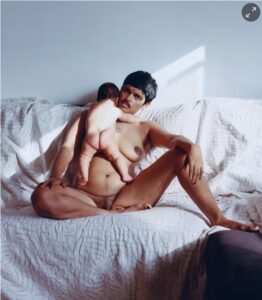
The viewer (does one view art or consume it these days) is confronted with a naked woman with a moustache, sitting legs akimbo and wearing a a stony eyed expression of what could be ennui or perhaps annoyance, but which ultimately is as inscrutable as Clint Eastwood in a 70’s spaghetti western. Her posture is rigid and unyielding and her display of genitalia, is worthy of the most macho of beach jocks in a budgie smuggler, except there’s no budgie and it’s not being smuggled. Draped across her shoulder and lying across her right breast is a naked baby. The “artist” is obviously trying to provoke two expectations, the cliched stock image of the naked mother cradling a baby evoking sentimentalized notions of motherhood and simultaneously, the eroticized, pornographic, expectation associated with an image of a woman with her legs open. These she then undermines with the moustache and the facial expression.
Very clever.
Being a parent is certainly redefined here. But as what? The woman in the photograph brings to my mind one of Harry Harlow’s wire monkeys from his Rhesus monkey experiments from the 1950’s which provided experimental support for Bowlby’s attachment theory which speaks about what characteristics of the infant, caregiver relationship foster healthy emotional and physical development. In this image, the only ingredient of Bowlby’s thinking that this parent is providing is a warm body, and even that looks as if it is begrudgingly provided.
Here’s something else we know about infant development. Not long after birth, infants are sensitive to gaze. At only a few months they will stare openly and long into a caregiver’s eyes and not only that, will move their eyes to follow a caregiver’s gaze. What’s happening in that infant gaze is this – mirror neurons connected directly to the ocular nerve and linking the visual system with the emotion regulation centers of the brainstem are synchronizing the internal state of the caregiver with the infant.
It’s soothing.
It’s also answering a profound question. When you stare into a baby’s eyes you are telling the baby “This is the world you have arrived in.” “This is the kind of treatment you can expect from people close to you”. “This is the kind of being I am” and as a corollary “This is the kind of creature you are”.
Let’s look at the gaze in this photograph which is fixed on us. The gaze is stony, clenched and impassive. Is it perhaps, vaguely accusatory? Is it a stretch to say that it might be resentful? Certainly, it is not warm.
How might it answer those primal questions? In this image, the caregiver seems to me to be wearing the baby like an accessory. The infant is incidental to the self-conscious message of the photograph and serves only to demarcate the context as one of motherhood. It is narcissistic – it is not about motherhood it is about the cleverness of the photographer and the characteristics of the mother – her moustache and her presentation of self.
The only artistic merit I find here is that it unintentionally reveals an attitude to parenthood popular in some discourses, that motherhood is oppressive. The mother looks uncomfortable, as if she would rather not have this limpet of flesh on her breast. Is that that reproach of the viewer and of society and even perhaps biology that has landed this creature on her in her gaze?
Back to those primal questions “What kind of being are you?” “What kind of world is this?” “What kind of treatment can I expect?”
In the post modern discourse that spawns art like this, these questions can be formulated like so, “What alternative knowledges of the phenomenon can be constructed?”
Three points come to mind.
First, I’m struck by the phrase “alternative knowledges” that was so current in the 1990’s when I was exposed to critical social theory. Today it reminds me of the “alternative facts” that are proffered about all sorts of things, from political scandals to the effect of fluoride in drinking water.
Second, the “alternative knowledge” about motherhood constructed here seems to me, one that is immensely destructive to what we know fosters good, healthy development of good people.
Third, and in response to this image, as a parent, social scientist and psychotherapist I will say this about being a parent to an infant – It doesn’t matter what facial hair you have or what shaped squishy bits you have between your legs, what matters is what’s in your gaze and your ability to hold yourself together while opening yourself to what’s in your charge.
Monkeys and bananas
The second piece of “art” the Guardian told me about is Maurizio Cattelan’s Banana duct taped to a wall. The title tells us exactly what it is. A Chinese cryptocurrency entrepreneur paid 6 million dollars for it. The banana itself cost 35 cents at the grocer down the road from the auction house on the morning of the auction which I think is supposed to be the point.
Cryptocurrency bids were accepted so the purchaser paid imaginary money for an extremely unimaginative piece of art. Once again this is probably the point the artist is trying to make – it’s about value. I suppose the art world imagines that this is sophisticated meta commentary on the whole late capitalist shindig?
I can’t think about it for too long before my head starts spinning in a tightening spiral of reflexivity. In my view it’s another artistic failure – it inspires nothing except cynicism. There is no value offered in place of the valueless system it seeks to address. It’s too self-conscious and far too “clever” to transcend the morass that has spawned it.
I think Maurizio is laughing all the way to the bank which hopefully will implode on its virtual foundations taking all its imaginary money with it.
It did remind me of a meme someone sent me which suggested that zoologists would devote significant resources to finding out what the fuck was wrong with a gorilla who stockpiled massive piles of bananas while the rest of his troop starved. By way of contrast, this primate puts that monkey on the cover of Forbes.
So where are the artists? And what can be said about a civilization in which the two pieces of art to cross my path over a couple of weeks are the two examples here?
I’ll leave those questions for another day but if you’ve read this far I’ll reward you by reminding you of that quote about god vanishing from Douglas Adams.
“The argument [disproving god] goes something like this: “I refuse to prove that I exist,'” says God, “for proof denies faith, and without faith I am nothing.”
Douglas Adams – Hitchiker’s Guide to the Galaxy
“But,” says Man, “The Babel fish is a dead giveaway, isn’t it? It could not have evolved by chance. It proves you exist, and so therefore, by your own arguments, you don’t. QED.”
“Oh dear,” says God, “I hadn’t thought of that,” and promptly vanishes in a puff of logic.
“Oh, that was easy,” says Man, and for an encore goes on to prove that black is white and gets himself killed on the next zebra crossing.”
Please consider subscribing to be notified when new content is published. It means a lot to the Shrink.